
Presented by Coronium.io
There’s a point almost every affiliate marketer hits sooner or later. A campaign is doing well, the numbers make sense, conversions are coming in steadily, and scaling feels like the obvious next step. So you increase budgets, spin up more accounts, push more volume — and at first, everything looks fine.
Then it starts slipping. Not all at once, and not in a way that’s easy to explain. Conversion rates dip a bit, approvals take longer than they used to, accounts behave less predictably. What used to run almost on autopilot now needs constant attention.
The strange part is that nothing “important” seems to have changed. Same creatives, same offer, same geo. But the outcome isn’t the same anymore. And that’s usually where people start tweaking the wrong things — adjusting angles, swapping creatives, trying to “fix” something that isn’t actually broken.
Scaling Changes Everything — Even When It Doesn’t Look Like It
It’s easy to think of scaling as just adding more traffic, but from the platform’s perspective it’s a different story. More volume means more signals, more patterns, more opportunities to analyze what’s happening behind the scenes.
At a smaller scale, your setup blends in. It looks like normal user activity. Once you scale, repetition becomes visible. Same actions, same structure, happening more often and across more accounts.
That’s usually enough. Platforms don’t need to block you to affect performance — they can just make things slightly harder. A bit more friction here, a bit more delay there. On their own, these changes don’t look dramatic. Together, they shift results in a noticeable way.
The Invisible Bottleneck: Network Trust and Session Consistency
Most performance issues at scale don’t show up in dashboards. They sit one layer deeper — in signals like IP reputation, session consistency, and how “natural” your traffic looks over time.
Every request your campaign sends carries context: where it comes from, how often similar activity happens, whether it behaves like a real user would. You don’t see these signals directly, but platforms rely on them heavily.
When everything looks clean, performance feels smooth. When it doesn’t, you start noticing small but persistent issues:
- more CAPTCHAs than usual
- accounts getting flagged even though nothing obvious changed
- approvals slowing down or becoming inconsistent
- campaigns struggling to scale past a certain point
None of this happens because the offer suddenly stopped working. It’s the environment losing trust, slowly but steadily.
Why Shared Proxy Pools Fail Under Pressure
At smaller volumes, shared proxy solutions often feel “good enough.” They’re easy to access, relatively cheap, and in many cases they do the job.
The problem only becomes visible when you start pushing volume.
You’re not the only one using those IPs. Other users run completely different setups through the same pool — different niches, different behaviors, sometimes not the cleanest traffic. Over time, that leaves a footprint.
At low scale, you barely notice it. At higher scale, you start hitting those same IPs more often — along with whatever history they carry.
That’s when performance becomes unpredictable. Not completely broken, but inconsistent enough to slow everything down.
Shared vs Dedicated: What Actually Changes
To make the difference clearer, here’s how these setups behave side by side:
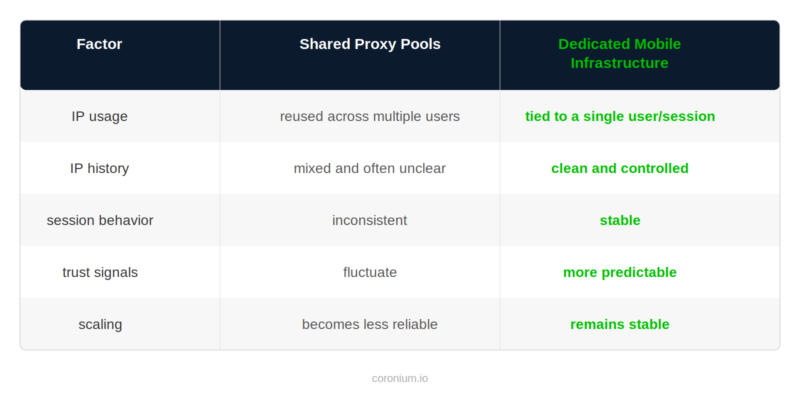
This is why two campaigns that look identical on paper can behave very differently once they scale.
What Actually Scales: Dedicated Mobile Infrastructure
If scaling exposes weak points, then growth depends on removing them. That’s where infrastructure starts to matter just as much as the campaign itself.
Dedicated mobile setups work differently. Instead of shared pools, they rely on real devices with SIM cards, so each session comes from an environment that looks much closer to a real user.
In practice, that means:
- no overlap with other users
- no inherited IP history from unknown sources
- consistent behavior across sessions
That alone doesn’t magically improve performance — but it removes the noise that usually causes problems at scale.
From Theory to Practice: What Changes After Switching
When teams move away from shared environments, the difference usually isn’t dramatic — and that’s exactly the point.
Campaigns don’t suddenly spike. They just stop degrading under pressure.
You spend less time reacting to random issues and more time actually optimizing. Accounts last longer, approvals feel more consistent, and scaling doesn’t come with the same level of risk.
The biggest change is probably psychological. When the setup is stable, you’re not second-guessing every move.
Where Coronium.io Fits In
This is the layer Coronium.io focuses on. Instead of shared proxy pools, it uses real 4G/5G devices with SIM cards, where each session runs through its own dedicated unit.
That separation matters more than it might seem at first. It removes overlap between users, keeps IP history clean, and makes session behavior more predictable — especially when volume increases.
For campaigns that already work and simply need to scale without falling apart, this is often the missing piece.
Conclusion
When a campaign starts breaking during scaling, it’s tempting to keep adjusting what’s visible — creatives, angles, targeting. Sometimes that helps. Sometimes it doesn’t.
But if the environment underneath isn’t stable, those fixes only go so far.
Scaling doesn’t just test your strategy. It tests everything behind it. And once that layer starts to fail, performance follows — even if everything else looks right on the surface.
FAQ
Why do campaigns often perform worse after scaling?
Because scaling makes patterns more visible. What looked normal at a smaller volume can start triggering additional checks once the same behavior repeats more often. That added friction affects performance, even if nothing obvious changes in the campaign itself.
Are mobile proxies actually better than residential proxies for affiliate campaigns?
It depends on the setup, but in cases where trust and consistency matter, mobile IPs tend to behave more reliably. They come from real carrier networks and are closer to typical user traffic, especially when tied to physical devices.
How does IP trust affect conversion rates?
Indirectly, but significantly. If traffic is constantly challenged, delayed, or limited before reaching the conversion stage, overall performance drops. High-trust environments help keep the user flow uninterrupted.
Can proxy choice really impact account bans and restrictions?
Yes. If multiple users share the same IPs or if those IPs have a problematic history, accounts are more likely to inherit that risk. Dedicated environments reduce that exposure.
What should you look for in proxy infrastructure when planning to scale?
Consistency and isolation. You want sessions that aren’t influenced by other users and behave predictably as volume increases. Without that, scaling will always introduce instability.